Shopify vs WooCommerce: Which Platform is Best for E-commerce Brands?
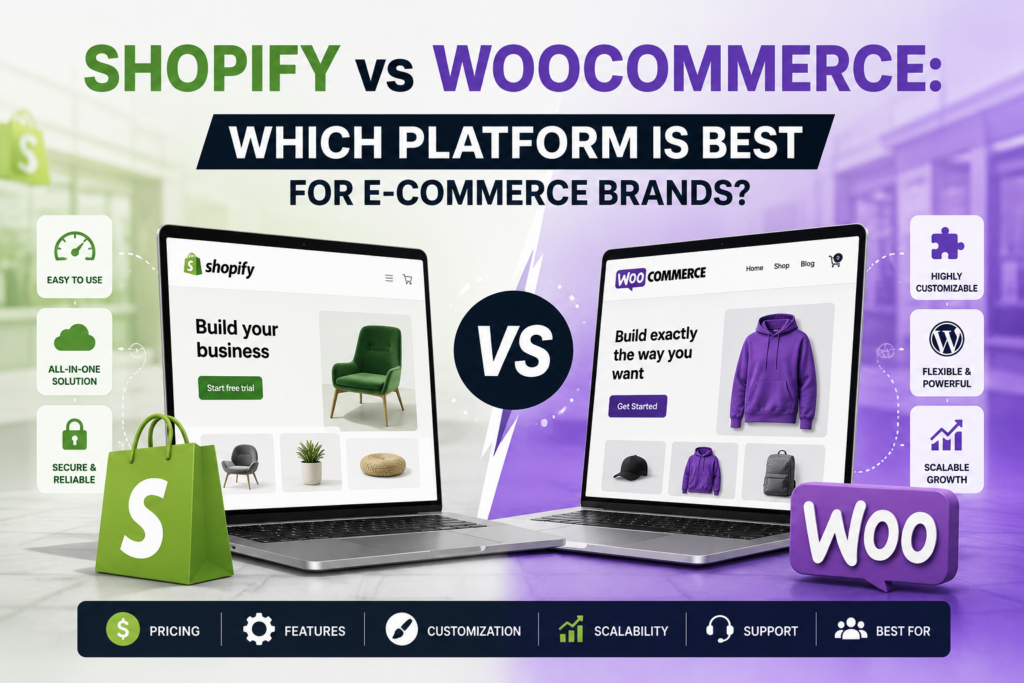
The Platform Decision That Shapes Your Business
Choosing between Shopify and WooCommerce is one of the most consequential decisions you will make for your ecommerce business. Get it right and you have a foundation built for growth. Get it wrong and you spend years fighting your own platform instead of scaling your brand.
This is not a shallow “both are great” comparison. This guide gives you an honest, data-driven analysis of both platforms across every dimension that actually affects revenue: setup time, ongoing cost, SEO capability, conversion optimization, scalability, and long-term total cost of ownership.
By the end, you will know exactly which platform fits your specific situation, and what steps to take next.
Platform Overview: What You Are Actually Choosing Between
What is Shopify?
Shopify is a fully hosted Software-as-a-Service (SaaS) ecommerce platform. You pay a monthly subscription and Shopify handles everything: hosting, security, software updates, SSL certificates, CDN, and checkout. You focus entirely on your products and marketing. Shopify is purpose-built for selling online and has no other job.
Key insight: Shopify’s biggest strength is what it removes from your plate. Every technical decision is already made for you at a level most businesses cannot match on their own.
What is WooCommerce?
WooCommerce is a free open-source ecommerce plugin for WordPress. It transforms any WordPress site into an online store. Because WordPress powers 43 percent of all websites on the internet, WooCommerce has massive reach and a vast plugin ecosystem. However, “free” is misleading: you still need to pay for hosting, a domain, SSL, security plugins, premium extensions, and developer time.
Important distinction: WooCommerce is free to install but the total cost of ownership is often higher than Shopify once you account for hosting, security, plugins, and developer hours.
Full Feature-by-Feature Comparison: Shopify vs WooCommerce
Here is a complete head-to-head comparison across the 15 factors that matter most to ecommerce brands.
| Feature | Shopify | WooCommerce | Winner |
|---|---|---|---|
| Setup Time | Minutes | Hours to days | Shopify |
| Hosting | Fully managed | Self-managed | Shopify |
| Monthly Cost | $39 to $399+ | $0 plugin | WooCommerce |
| Security & SSL | Automatic | Manual setup | Shopify |
| Customization | Theme-limited | Unlimited | WooCommerce |
| SEO Control | Good, restricted | Full control | WooCommerce |
| Scalability | Auto-scaling | Needs setup | Shopify |
| Payment Options | Shopify Pay preferred | Any gateway | WooCommerce |
| Transaction Fees | 0.5% to 2% | None | WooCommerce |
| Checkout Control | Limited | Full control | WooCommerce |
| Apps / Plugins | 8,000+ apps | 59,000+ plugins | Tie |
| Support | 24/7 official | Community only | Shopify |
| Technical Skill | None needed | Medium to high | Shopify |
| Multi-currency | Built-in | Plugin required | Shopify |
| POS / Retail | Native POS | Third-party | Shopify |
Real Cost Breakdown: Shopify vs WooCommerce
This is where most comparisons mislead you. WooCommerce appears free. Shopify appears expensive. The reality is more nuanced once you calculate total annual cost of ownership.
Shopify Total Annual Cost
- Shopify plan: $468 to $4,788 per year (Basic to Advanced)
- Domain name: approximately $14 per year
- Email marketing app (Klaviyo): from $0 to $150+ per month depending on list size
- Review app (Judge.me): $15 per month
- Transaction fees: 0 percent with Shopify Payments, 0.5 to 2 percent without
- Theme: $0 (free) to $400 (one-time, paid)
- Total for a growing store: approximately $700 to $3,500 per year
WooCommerce Total Annual Cost
- WooCommerce plugin: free, but hosting required
- Managed WordPress hosting (Kinsta, WP Engine): $300 to $2,400 per year
- SSL certificate: $0 (Let’s Encrypt) to $100 per year
- Security plugin (Wordfence, Sucuri): $100 to $500 per year
- Premium WooCommerce extensions: $200 to $1,000+ per year
- Developer hours for maintenance and updates: $500 to $5,000+ per year
- Total for a growing store: approximately $1,200 to $9,000 per year
Verdict on cost: WooCommerce can be cheaper for tiny stores with minimal plugins and technical owners who do their own maintenance. For most ecommerce brands, Shopify’s all-inclusive cost is more predictable and often lower once you account for developer time.
SEO Comparison: Shopify vs WooCommerce
SEO is a major battleground in this debate. The truth is more nuanced than the “WooCommerce wins SEO” narrative you will read on most WordPress blogs.
Where WooCommerce Wins on SEO
- Full control over URL structure including subfolder organization
- Ability to edit robots.txt, .htaccess, and server-level configurations
- Yoast SEO and Rank Math plugins offer deep on-page optimization tools
- Full Schema markup control through plugins and custom code
- No URL restrictions: Shopify forces /collections/, /products/, /pages/ prefixes
- Better for content-heavy sites where a blog drives significant organic traffic
Where Shopify Holds Its Own on SEO
- Automatic sitemap generation and submission
- Built-in CDN means faster page loads globally, a ranking signal
- Online Store 2.0 themes are optimized for Core Web Vitals out of the box
- Native structured data for products, reviews, and breadcrumbs
- Less risk of a misconfigured plugin breaking your entire site’s indexing
- Shopify handles canonical tags automatically, preventing duplicate content
Real talk: WooCommerce gives you more SEO control. But control only helps if you use it correctly. A well-configured Shopify store consistently outranks a poorly managed WooCommerce store. For most ecommerce brands that are not SEO specialists, Shopify’s automated SEO handling reduces risk significantly.
Scalability: Which Platform Grows With Your Brand?
Scalability has two dimensions: traffic scalability and business model scalability. Both platforms approach this very differently.
Shopify Scalability
Shopify’s infrastructure auto-scales with your traffic. During Black Friday, Shopify handled over 40 million requests per minute across its merchant base with zero downtime. You never need to upgrade your hosting plan, configure a CDN, or worry about your store crashing during a product launch. Shopify Plus, the enterprise tier, powers brands doing hundreds of millions in annual revenue on the exact same infrastructure.
WooCommerce Scalability
WooCommerce can scale to very high volumes, but it requires engineering investment to do so. You need managed cloud hosting (AWS, Google Cloud, or a premium managed WordPress host), database optimization, object caching with Redis or Memcached, and a CDN configuration. Done correctly, WooCommerce handles massive scale. But done incorrectly, your store crashes during your most important traffic events.
WooCommerce scalability is not automatic. It requires ongoing infrastructure management and cost that increases with your traffic. Budget for this before you launch.
Conversion Optimization: Shopify vs WooCommerce
Conversion rate is the metric that turns traffic into revenue. Platform choice has a direct impact on your ability to optimize conversion.
Shopify CRO Advantages
- Checkout is hosted and optimized by Shopify with decades of conversion data behind it
- Shop Pay checkout reduces friction with one-click purchasing for returning customers
- Native abandoned cart recovery emails built in
- Cart drawer UX available natively in most themes
- Shopify’s checkout converts at industry-leading rates: 15 percent higher than average
WooCommerce CRO Advantages
- Complete checkout customization: any field, any layout, any logic
- No forced Shopify branding at any point in the purchase flow
- A/B test your checkout with full control, including page structure
- Custom payment flows for complex products (subscriptions, deposits, pre-orders)
- Conditional checkout fields based on product type, customer location, or cart value
For standard DTC ecommerce, Shopify’s checkout consistently outperforms custom WooCommerce checkouts because it is optimized by a dedicated team using data from millions of transactions. The exception is highly customized purchase flows where WooCommerce’s flexibility becomes a genuine advantage.
Who Should Use Shopify and Who Should Use WooCommerce?
After comparing both platforms across every major dimension, here is the definitive decision framework.
Migrating Between Platforms: What You Need to Know
Many brands start on one platform and eventually migrate to the other. Here is what that process actually involves.
Migrating from WooCommerce to Shopify
- Products, customers, and orders can be migrated using Shopify’s official importer or Cart2Cart
- URLs will change: all /product/ and /category/ paths become /products/ and /collections/ — set up 301 redirects immediately
- SEO impact: expect a 10 to 20 percent traffic dip for 4 to 8 weeks during migration, then recovery
- Custom functionality needs to be rebuilt using Shopify apps or custom app development
- Timeline: 4 to 12 weeks depending on catalog size and customization complexity
Migrating from Shopify to WooCommerce
- Export products via CSV and import to WooCommerce — customer export is more complex
- Set up managed WordPress hosting before migration begins
- Recreate all automation flows, email sequences, and app functionality in WooCommerce equivalents
- Implement security hardening immediately: Shopify handles this, WooCommerce does not
- Timeline: 6 to 16 weeks for a mid-size store with complex functionality
Do not migrate platforms without professional support. SEO damage from incorrect redirects and indexing errors during platform migration can take 6 to 12 months to recover from.
Frequently Asked Questions
Is Shopify better than WooCommerce for SEO?
WooCommerce offers more technical SEO control. However, Shopify handles SEO fundamentals automatically and its CDN-backed page speed gives it an edge on Core Web Vitals. For most ecommerce brands that are not running dedicated SEO teams, Shopify is the lower-risk choice. For content-heavy stores where a blog drives significant organic traffic, WooCommerce has genuine SEO advantages.
Is WooCommerce really free?
The plugin is free to install, but running a WooCommerce store costs money. You need hosting ($25 to $200 per month), premium extensions ($200 to $1,000+ per year), a security plugin, and typically developer time for maintenance. Total annual cost for a growing WooCommerce store is commonly $1,200 to $9,000 when all costs are included.
Which platform is easier for beginners?
Shopify is significantly easier for beginners. You can have a functioning store live within hours with no technical knowledge. WooCommerce requires familiarity with WordPress, hosting management, plugin configuration, and basic web security practices. For non-technical founders, Shopify is the clear choice.
Can I switch from WooCommerce to Shopify later?
Yes, migration is possible and many brands make this transition as they grow. Expect a 4 to 12 week migration timeline and a temporary SEO traffic dip of 10 to 20 percent for 4 to 8 weeks. Work with an experienced migration specialist to minimize SEO impact and ensure zero data loss.
Which platform has better apps and integrations?
WooCommerce has 59,000+ plugins versus Shopify’s 8,000+ apps. However, Shopify’s app ecosystem is more curated and apps are vetted for quality and security. For most common ecommerce functions (email marketing, reviews, loyalty, upsells), both platforms have excellent options. WooCommerce wins on pure volume; Shopify wins on average quality and reliability.
After analyzing both platforms across setup, cost, SEO, scalability, conversion, and long-term ownership, our recommendation is clear:
Choose Shopify if you are building a DTC ecommerce brand that wants to launch fast, scale without infrastructure headaches, and focus on growth rather than technical maintenance. Shopify removes friction at every level of your operation.
Choose WooCommerce if you already have a WordPress content ecosystem, need deep customization that Shopify cannot match, or have technical resources to manage the platform. WooCommerce rewards technical investment with flexibility that Shopify does not offer.
For most ecommerce brands reading this, Shopify is the right choice. The data backs it up: Shopify stores on average convert at higher rates, launch faster, and scale with less operational overhead than comparable WooCommerce stores.
Not Sure Which Platform is Right for Your Brand?
Kodavia's team analyzes your business model, growth goals, and technical requirements to recommend and build the exact ecommerce setup that converts. No guesswork, just data-driven decisions.